Photochromic Contact Lenses sound convenient: a lens that adjusts its tint as light changes, whether you are walking from a shaded street into bright sun or sitting beside a sunny window. The idea is appealing. The details matter, though. Lens designs differ, and tint response may vary with lighting, temperature, and the wearer. These lenses also do not necessarily replace sunglasses or provide complete protection from ultraviolet light. Small print matters.
Before buying, check whether the product is available for your prescription and intended wearing schedule. Ask an eye-care professional to confirm fit, vision needs, and suitability for your eyes. A lens that feels comfortable in a store may feel different after several hours. That is worth considering. Compare the manufacturer’s guidance on activation, care, replacement, and expected performance, rather than relying only on dramatic product photos. If you drive, work outdoors, or spend long periods at screens, describe those routines during your consultation. Different settings can call for different vision solutions.
The seven tips in this guide focus on practical questions: what the tint does, how quickly it changes, what protection it offers, and how to assess comfort and cost. They also cover prescription compatibility and when to seek professional advice. No lens works perfectly for everyone. A careful choice can help you set realistic expectations before placing an order.
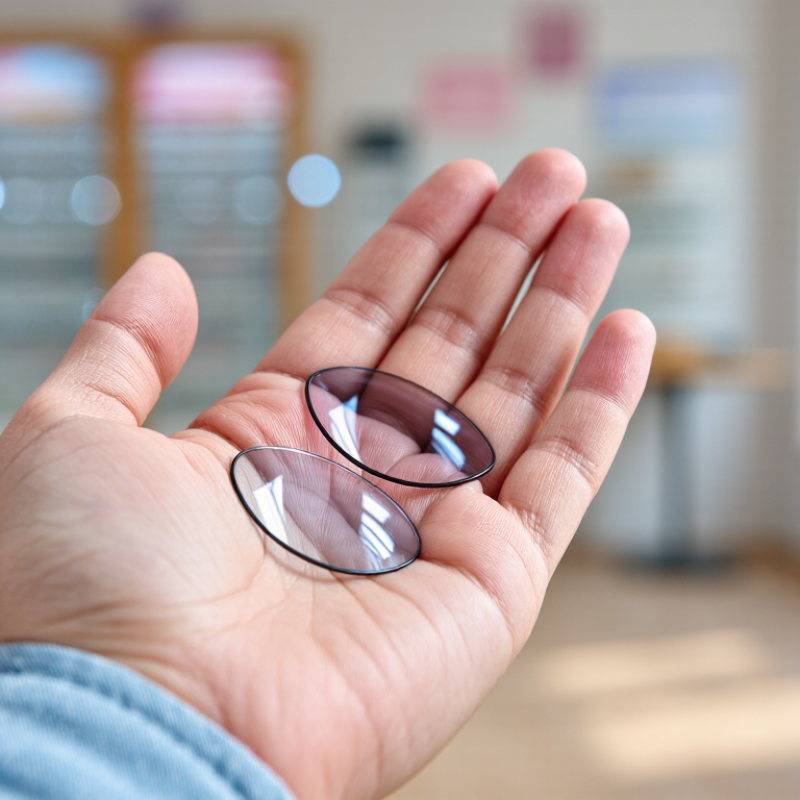
Confirm Your Prescription and Lens Fit Before Comparing Features
Before comparing tint speed or light-filtering claims, confirm that your prescription is current. Contact lens prescriptions include more than vision power. They may specify lens material, base curve, diameter, and replacement schedule. A lens that looks right on paper can still move too much or feel dry. A feature list can wait.
Ask an eye-care professional to check the fit on your eyes, not just review the numbers. During a fitting, mention whether the lens shifts when you blink, feels gritty by afternoon, or leaves your vision fluctuating. Small details matter. Photochromic lenses do not replace sunglasses, and their response can vary with lighting and lens design. I would not assume a darker tint means better comfort; that needs personal testing. If your eyes are irritated or your vision changes, stop wearing the lenses and seek professional advice. It is easy to focus on the clever technology and miss the basics. I have to remind myself of that, too. Once prescription, fit, and wearing schedule are confirmed, compare features that suit your daily routines.
Check Your Prescription and Lens Fit First
Before comparing photochromic features, confirm your current contact lens prescription and fit with an eye-care professional. The chart shows common replacement schedules—not a recommendation or a guarantee that every schedule is available for photochromic lenses. Follow the schedule specified for your prescribed lenses.
Daily disposable lenses are replaced after one day of use; two-week lenses are replaced every 14 days, and monthly lenses are replaced every 30 days. Never extend a lens’s prescribed replacement schedule.
Check FDA Approval: The First Light-Adaptive Contact Lens Was Approved in 2018
The first light-adaptive contact lens received U.S. FDA approval in 2018. That milestone matters, but it is not a blanket endorsement of every photochromic lens. FDA review applies to a specific device, its materials, labeling, and intended use. Check current FDA records and package information rather than relying on a retailer’s short product description. Small detail. Important.
When comparing lenses, ask your eye-care professional whether the approved design suits your prescription, eye health, and daily routine. Mention long screen sessions, driving, and time outdoors; these conditions can affect comfort. Review replacement timing, cleaning instructions, and any limits on use. A lens that darkens in sunlight does not replace sunglasses or guarantee complete UV protection. Verify the label. Never guess.
Tip: Ask what “light-adaptive” means for that lens, including how quickly it changes and clears indoors. Check whether its tint affects night driving or color perception. Ask what to do about redness, pain, blurred vision, or unusual dryness; remove the lens and seek professional advice if symptoms persist. I would not assume this technology feels identical to sunglasses. It may not. Before buying, get a valid contact-lens prescription and a fitting. Comfort can vary, and early impressions are not always reliable.
Compare Model-Specific Filtering: 11% Indoors and 30% Outdoors for Blue-Violet Light
An 11% indoor and 30% outdoor reduction in blue-violet light may sound like a clear comparison. But those figures apply only to the specific lens model and test conditions. Check which wavelengths were measured, how “filtered” was defined, and whether the numbers describe transmission or reduction. Small print matters.
Picture reading beside a bright window, then stepping into midday sun. The lens may change its tint, but its blue-violet filtering figures are not automatically a measure of comfort or eye protection. Ask for the test details, including whether indoor and outdoor results came from the same method. If the information is vague, treat the percentages cautiously. They are useful, but not the whole story.
Compare the model’s figures with your routine: screen time, commuting, and time outdoors. Also ask an eye-care professional whether the lens suits your prescription and wearing needs. Photochromic performance can vary with lighting and surroundings, so a lens that darkens outdoors may behave differently behind a car window. I would not choose by the larger number alone. The exact test and fit matter.
7 Tips for Buying Photochromic Contact Lenses - Compare Model-Specific Filtering: 11% Indoors and 30% Outdoors for Blue-Violet Light
| Buying consideration |
What to compare |
Useful buying note |
| 1. Blue-violet filtering claims |
Check the stated transmission or filtering percentage for each specific lens model and for both indoor and outdoor test conditions. |
The 11% indoor and 30% outdoor figures in the title should be treated as model-specific claims, not universal performance. Confirm the wavelength range, test method, and whether the numbers describe transmission or reduction. |
| 2. UV protection |
Compare the lens’s stated UV-blocking classification and the test standard provided in its product documentation. |
UV-blocking contact lenses do not cover the entire eye or surrounding skin. They are not a substitute for UV-blocking sunglasses. |
| 3. Prescription and fit |
Confirm that the lens is available in the required prescription and is fitted for the wearer’s eye measurements. |
Contact lenses require a valid prescription and professional fitting; a glasses prescription alone may not provide all the information needed. |
| 4. Wear and replacement schedule |
Compare whether the lens is approved for daily wear or another schedule, and note its prescribed replacement interval. |
Follow the specific lens instructions and eye-care professional’s advice. Do not extend wear or replacement periods for convenience. |
| 5. Comfort and oxygen transmission |
Review material information, oxygen-transmission data when supplied, and wearer guidance for dryness or discomfort. |
Comfort varies by person and fit. A filtering claim alone does not indicate that a lens will be comfortable or suitable for extended wear. |
| 6. Activation conditions |
Check how the manufacturer describes lens tint or filtering changes under different lighting conditions. |
Performance can depend on the lens design and lighting environment; do not assume every photochromic lens changes identically indoors and outdoors. |
| 7. Care, handling, and support |
Compare care instructions, compatible cleaning products, availability of professional follow-up, and the process for reporting problems. |
Use only the care method specified for the lens. Remove the lenses and seek professional advice if you experience pain, unusual redness, or vision changes. |
Review Material and Replacement Schedule: Senofilcon A, 38% Water, Two-Week Wear
Senofilcon A is a silicone hydrogel material often listed with 38% water content. Those figures describe the lens, but they do not predict comfort by themselves. Lens thickness, fit, tear film, and wearing habits also matter. A lens that feels fine in the morning may feel dry after hours in heated indoor air. Not a comfort guarantee.
Check that the photochromic feature and the base material are described separately. The material name does not tell you how quickly the lens changes tint or how much light it filters. Ask an eye-care professional whether the lens suits your prescription and eye health. Photochromic contacts do not replace sunglasses, especially outdoors, where the eyes remain exposed from the sides.
A two-week replacement schedule means following the specific wear instructions, not stretching a pair until it feels worn. Remove and clean reusable lenses as directed, and replace them on the scheduled day. Never sleep in them unless your eye-care professional has explicitly approved that wear pattern. It is easy to lose track. Mark the opening date on the case or set a phone reminder; then discuss persistent redness, pain, or blurred vision promptly with a professional.
Keep Sunglasses in Your Plan: UV-Filtering Contacts Do Not Replace Them
Photochromic contact lenses may darken in sunlight, but they do not shield the whole eye or the skin around it. The U.S. Food and Drug Administration advises that UV-blocking contacts do not replace protective eyewear. Not quite. A lens sits over the cornea; light can still reach the eye from the sides and above. Keep sunglasses in your plan, even when your contacts change tint.
The World Health Organization’s 2023 ultraviolet-radiation guidance estimates that about 15 million people worldwide are blind from cataracts, with up to 10% of cases potentially linked to UV exposure. This is a population estimate, not a prediction of your personal risk. Choose sunglasses labeled UV400 or 99–100% UVA/UVB protection, and consider a close-fitting frame for less side exposure. A brimmed hat adds shade on a clear beach or beside a snowy path. Clouds can make UV feel less intense, but they do not make sunglasses pointless. Remembering both can feel fussy; it is still a useful habit.
Conclusion
When shopping for Photochromic Contact Lenses, start by confirming that your prescription is current and that the lenses fit your eyes properly. Once your eye-care professional has confirmed these basics, compare light-adaptive features rather than choosing by convenience alone. Check that the lens type has appropriate regulatory approval; the first light-adaptive contact lens received FDA approval in 2018. Filtering performance can vary by model, so review the specific figures for the lenses you are considering, including reported blue-violet light filtering of 11% indoors and 30% outdoors.
Also consider the lens material and replacement schedule. The option described in this outline uses senofilcon A, contains 38% water, and is intended for two-week wear, but suitability depends on your individual needs and professional guidance. Keep sunglasses in your routine as well: UV-filtering contacts do not cover the whole eye or replace sunglasses. A careful comparison of fit, filtering, material, wear schedule, and sun protection can help you make an informed choice.

 Chic Contacts